American Political Culture

‘The American Dream’ is what many people in America work towards to become successful and make their dreams come true, and make what they really want a reality. People in America have dreams of owning a nice home, fancy cars, and building a happy family.

What are the Core Values of the American Government? They are the right to life, liberty, and the “pursuit of happiness” and how families can make their lives better through the hard times.

Assignment: Please read chapters one to five in your American Government textbook and watch the following video to write your essay explaining the topic of this assignment, which is ‘American Political Culture’ that shapes our lives in the United States of America and is about the core values and beliefs that we have to live our lives accordingly.

The U.S. system of Checks and Balances has effectively ensured that every branch of government becomes powerful.  By creating a system where each branch of government can check and balance the power of the other branches, the U.S. government has maintained a balance between the nation’s stability.  Congress has become increasingly divided along partisan lines with Republicans and Democrats often disagreeing on critical issues such as healthcare, immigration, and the amendments in the Constitution of the United States. The Supreme Court has the power to declare acts of Congress or the President.  There are times when the branches of government can reflect their political views and aspects with their leadership.  The effectiveness of this system is evident in the way each branch can limit the powers of the other branches.  For example, the President can veto legislation passed by Congress, but Congress can override that veto with a two-thirds majority vote.  The Supreme Court can declare laws passed by Congress or executive actions by the President.  The challenges of individual rights in the United States are particularly regarding the importance of the factors that contribute to a negative perception of the core values that all individuals have and the rights of the citizens of the United States of America.  Federalism can be defined with misleading ease as the division of powers and function between the central government and the state governments.  It causes confusion as most people assume that federalism means giving more power to the “federal government”.  It is revolutionary because it is how people live in unity in different parts of the country.  A unitary system differs from the federal system because it has two levels of government: the federal government is the division and sharing of power between the national government.  The lower levels of government have limited independent power.  The discipline of political science contributes to critical thinking by the American people gathering information about what they want from the government, or what they want the leaders to do for them.  Political Science encompasses many aspects of government.  The political views have been causing disagreements on so many levels.  It may be to choose a candidate for the President of the United States during the election with resolving issues, or aspects that may help to resolve issues that are present in the United States of America today,  and to choose the right leader for the American people.  America is built on the four core values: Liberty, Equality, Democracy, and Unity.  Liberty means Freedom, Equality means treating others fairly, democracy means that what the people want matters, and Unity means living together or being undivided.  Liberty means the state of being free from restrictions and limitations from the control of an individual who becomes a leader in the United States of America.  Equality means the state of being equal, having rights and opportunities.  Democracy means a system of government by the people or all the eligible members of a nation.  The power comes from the people, unlike an autocratic government.  Equality refers to the right to participate in politics equally.  Unity means that all parties have decided to work together towards a common goal.

American Political Culture and Core Values

https://ps101.community.uaf.edu/2021/09/01/instructions-for-practicum-1/

Non-Western Blog

Baleen Basket of a Hunter and a Polar Bear

Baleen Basket with a hunter and a polar bear handle

The Baleen Basket with a carved Ivory hunter and a polar bear handle on the cover was made by George Omnik in 1961. My reaction to this artwork is so intriguing!! I have to say I’d like to own a Baleen Basket. The Baleen Basket was made in Alaska! The Art Elements of the Baleen Basket are pattern, color, and formation. The Baleen Basket has patterns of the way that the basket weaving of the baleen was done. The color of the baleen and the ivory are black and white. The formation of the carving is a polar bear and a hunter.

Baleen is a flexible and waterproof material, lending itself perfectly to the art of basket weaving.

A culmination of beauty and functionality, this basket nods to the deep connection Iñupiaq still have today with our natural environment.

Baleen Basket-Polar Bear and a Seal Handle

Baleen Basket with a polar bear and seal handle

The baleen basket with a polar bear and seal handle was made by George Omnik from Point Hope, Alaska. It is also displayed at the Honolulu Museum of Art. The art elements in the basket are pattern, color, and formation. The pattern of the design is how the artist weaved the basket clockwise. The color of the basket is that the baleen is black and the ivory that was carved into a polar bear and a seal, is white. The formation of the handle on the lid was carved into a polar bear and a seal on an iceberg.

George Omnik

George Omnik was born on July 1, 1905, and died in September of 1978. George Omnik was an Alaskan Inupiaq Eskimo from Point Hope, Alaska. He was an early Iñupiaq basket maker whose work largely distinguished the Point Hope style of baleen basket-an art form developed in the early twentieth century by Iñupiaq artists in the Point Barrow region and spread to communities throughout Alaska. Omnik was the first man in the community to practice basket making, and his use of flat lids, wide wefts and shouldered cylindrical shapes influenced the basketry of later Point Hope makers, like Luke Koonook and Gregg Tagarook.

He was a known artist for basket weaving. Omnik expertly executes a clockwise weave to produce a lidded basket with a deftly carved ivory and ink topper depicting a fight scene between a hunter and a bloody polar bear that contrasts a black sheen of the baleen.

In Praise of Wāhine

In Praise of Wāhine

The painting “In Praise of Wāhine” was painted by Linda Rowell Stevens. The art elements in the painting are the lines, color and contrast. The lines of the fire from the lava that are in the goddess’s hands, the color of her dress is red, the color of the fire of the lava is orange, yellow and the lava is grey. The contrast of the lava in her hands looks hot, but the goddess depicts that she has the will power to send the lava away that comes out of the volcanoes. My reaction to the painting is that the goddess is strong-willed and powerful.

Linda Rowell Stevens

Linda Rowell Stevens was born in Utah. Her family moved to Connecticut and then to Virginia where she attended college at Virginia Commonwealth University. Linda moved to Hawaii in 1972 at the age of 21. Linda Rowell Stevens is known to be a Hawaiian Legends artist.

View of the Whirlpools at Awa

View of the Whirlpools at Awa

The “View of the Whirlpools at Awa” was painted in 1857 by Utagawa Hiroshige. The painting is located at the Metropolitan Museum of Art in New York, New York. The name of the painting is called “Naruta Whirlpool” Awa Province from the series Views of Famous Place in the Sixty-Odd Provinces”. The art elements of the painting are lines, color and formation. The lines that are in a spiral shape is what forms the whirlpool and the waves. The color of the water that shapes the whirlpool and the waves are blue and white. The formation of the whirlpool, is the spiral form that creates the whirlpool.

Utagawa Hiroshige

Utagawa Hiroshige

Utagawa Hiroshige was born Andõ Hiroshige 1797 in Edo, Japan. He died on October 12, 1858 in Japan. He was a Ukiyo-e artist. Hiroshige was best known for his horizontal-format landscape series “The Fifty-Three Stations of the Tōkaidō”. He was known for printing and painting.

https://www.mutualart.com/Artist/George-Omnik/11F3A48FCC5F5253/Biography

https://en.wikipedia.org/wiki/Visual_arts_by_indigenous_peoples_of_the_Americas

https://www.inuitartfoundation.org/iaq-online/circle-george-omnik-s-baleen-basket

https://en.wikipedia.org/wiki/Baleen_basketry

https://www.lindarowellstevens.com/about

https://vilda.alaska.edu/digital/collection/cdmg2/id/6572/

http://mmancina.weebly.com/non-western-art.html

https://en.wikipedia.org/wiki/Hiroshige

Mid or Post Modern Exhibit

Loopy

Loopy

Loopy is a high gloss Fujiflex print done by Jeff Koons in 2000. I like explaining the art elements in this print. There are lines that contour Loopy’s facial features like his nose, his excited eyes, and his expression, the spoon with cream whip and a red cherry on top, and the cereal bits. There are different colors such as yellow, white, green, red, grey, maroon and black in the picture. Loopy’s face and the creamy whip are white, the cereal bits are yellowish-tan, Loopy’s nose and the cherry are red, his eyes are black, the plastic pieces are green, yellow, and blue. The spoon is shiny silver. There are different shapes, like the cereal bits are circle, and his eyes are oval. The pattern of the cereal bits make a pattern along the bottom of the print.

Balloon Dog

Balloon Dog by Jeff Koons

Balloon Dog was made by Jeff Koons in 1993. Two of the Balloon Dog sculptures are located at the San Francisco Museum of Modern Art and the Broad Contemporary Art Museum in downtown Los Angeles. The “Balloon Dog” is a representation of breath and human life. This sculpture is in the 1980 to present influence of Post Modern Art.

The art elements of Balloon Dog included in the sculpture are lines, shapes, color, contrast, pattern and formation. The lines are curved and rounded that makes the shape of the “Balloon Dog“. In this picture, the color is pink. The shape is like a dog made with a long balloon. The contrast is that the “Balloon Dog” is shiny, and reflective. The contrast brightens the room with the light that reflects off of it. The pattern are the entire “Balloon Dog” are in the way the balloon is twisted and shaped to create the formation of the sculpture.

I want to connect this sculpture to my reaction to it, I remember when there was a guy that aired up long balloons and made all of us students a balloon dog out of the balloon by twisting it and twisting it again and thought that it was cool to try it on my own, but I could not do it without the help of the guy helping me with the step-by-step instructions on how to make them.

Jeff Koons

Jeff Koons

Jeff Koons is an American artist known for his reproductions of banal objects and turns them into high art icons. Koons was born in York, Pennsylvania on January 21, 1955, and he is currently 66 years old. Koons studied at the Maryland Institute College of Art Institute of Chicago and received a BFA at the Maryland College of Art in 1976. Koons’ work is in the 1980’s era of the postmodern art period.

“I’ve always loved Surrealism and Pop, so I just follow my interests and focus on them”

Jeff Koons

Moon, June, Spoon

Moon, June, Spoon sculpture

The Moon, June, Spoon sculpture was created 1987-1989 by Joseph Havel. It is made out of bronze. The sculpture is located at the Museum of Fine Arts in Houston, Texas. There are lines that create the shape of the sculpture. I see the shape of the moon, a branch, and a shovel. The contrast of the sculpture is a dark color, which is bronze and resin.

Dark Star

Dark Star

The sculpture “Dark Star” was created by Joseph Havel in 2015. It is made with bronze and patina. It is part of an art exhibit created by Joseph Havel at the Fine Art Gallery located in San Francisco, California.

There are lines, color, contrast, and form in the sculpture. The lines are like a cut out snowflake from paper and puffed out into the form of a disco ball. The color of the sculpture is black which takes the name of the “Dark Star” into a dimensional perspective, and the contrast is that it looks like a dark star with the lighting above it.

Joseph Havel

Joseph Havel

Joseph Havel is a postmodernist American sculptor in contemporary arts who was born in Minneapolis, Minnesota in 1954. Havel earned his BFA from the University of Minnesota in 1975, and his M.F.A at the Pennsylvania State University in 1979. Joseph Havel has many art exhibits that are on display at the Fine Art Gallery in San Franciso, California.

The Crawick Multivers-The Universe Cascade

The Universe Cascade

The Universe Cascade is located in the Garden of Cosmic Speculation at Portrack House, near Dumfries in South West Scotland. There are lines, color, and pattern in the landscaping creation of Charles Jencks. The lines make up the formation of “The Universe Cascade”, the colors are green and white, along with the shimmer of the water, and the pattern of the stairs makes it a mind-bending landscaping creation. I love the creation.

Garden of Cosmic Speculation

The Garden of Cosmic Speculation was created by Charles Jencks. The Garden of Cosmic Speculation is located at Portrack House, near Dumfries in South West Scotland. There are lines, color and shapes in the Garden of Cosmic Speculation. The lines make up the checkered squares and the spiraled mazes of the landscaping creation! I love the scenery and the landscaping work. It caught my eye, so I decided to make a blog on it.

Charles Jencks

Charles Jencks

Charles Jencks was an American cultural theorist, landscape designer, architectural historian, and co-founder of the Maggie’s Cancer Care Centres. He published over 30 books, and became famous in the 1980’s as a theorist of postmodernism. Jencks devoted his time to landform architecture, especially in Scotland. Charles Jencks was born on January 21, 1939 in Baltimore, Maryland, and died on October 13, 2019 in London, United Kingdom.

He attended the Harvard University Graduate School of Design in 1965, and also attended the University College London.

Citations

https://www.josephklevenefineartltd.com/artists/jeff-koons/jeff-koons-loopy.html

http://www.jeffkoons.com/

http://www.jeffkoons.com/biography-summary

https://www.guyhepner.com/product/loopy-by-jeff-koons/

https://en.wikipedia.org/wiki/Jeff_Koons#:~:text=Two%20of%20these%20sculptures%20are,BCAM)%20in%20downtown%20Los%20Angeles.

https://emuseum.mfah.org/objects/17643/moon-june-spoon

http://outsideofnewyork.com/354/

https://www.anthonymeierfinearts.com/exhibitions/joseph-havel/selected-works?view=slider#5

https://www.sciencephoto.com/media/129074/view/garden-of-cosmic-speculation

https://en.wikipedia.org/wiki/Charles_Jencks

https://www.charlesjencks.com/page-11

Early Modern Era

The Great Depression

An American Gothic painting during the Great Depression

The American Gothic painting was painted during the Great Depression, which lasted for over a decade from 1929 to 1941, when the World War II ended, and during the Early Modern Era. This painting was painted by Grant Wood in 1930. The Great Depression began in August of 1929 when the industrial economy crashed and the unemployment rates rose and families suffered.

The New Road

The New Road painting by Grant Wood

The “New Road” painting was created by Grant Wood in 1939, during the Great Depression and during the Early Modern Era. The ‘New Road’ painting is located at the National Gallery of Art in Washington, D.C.

Grant Wood

Grant Wood, American painter

Grant Wood was born on February 13, 1891 in Anamosa, Iowa, and died on February 12, 1942 in Iowa City, Iowa. He attended the School of the Art Institute of Chicago. He was known for painting and his notable work is the “American Gothic” and the “New Road” paintings.

The New Deal

Migrant Mother painting of the “New Deal” by Dorothea Lange

“The Migrant Mother” was photographed by Dorothea Lange in 1936. The print is located at the Museum of Modern Art in New York, New York. Florence Owens Thompson was a full-blooded Native American Cherokee Indian. She was born on September 1, 1903, and died on September 16, 1983 in Scotts Valley, California. She was married to Cleo Owens, who was her first husband, and they both sought work as farm and mill workers. When he died in 1931 from Tuberculosis, Florence was left with six children to support on her own by picking cotton and other crops. Her furrowed brow and hand placed on her chin, displays anxiety and worry about her duties as a mother to nurture and protect her children.

Dorothea Lange

Dorothea Lange

Dorothea Lange was known for documentary photography and the famous photo of the “Migrant Mother” of Florence Owens Thompson. Dorothea Lange was born May 26, 1895 in Hoboken, New Jersey, and died on October 11, 1965 in San Francisco, California.

https://www.federalreservehistory.org/essays/great-depression

https://en.wikipedia.org/wiki/Grant_Wood

https://en.wikipedia.org/wiki/School_of_the_Art_Institute_of_Chicago

https://www.nga.gov/collection/art-object-page.61105.html

https://en.wikipedia.org/wiki/American_Gothic

https://smarthistory.org/seeing-america-2/dorothea-lange-migrant-mother-sa

https://www.moma.org/

https://new.artsmia.org/

https://www.history.com/news/migrant-mother-new-deal-great-depression

https://en.wikipedia.org/wiki/Migrant_Mother

https://en.wikipedia.org/wiki/Dorothea_Lange

Romantic Era

Grand Canyon of the Yellowstone

Grand Canyon of the Yellowstone

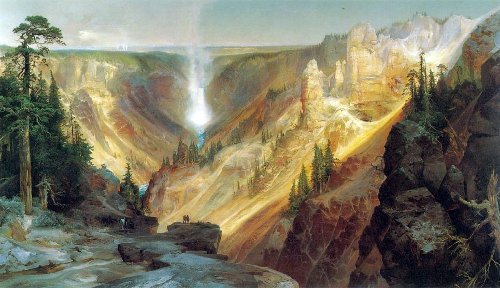
The Grand Canyon of the Yellowstone is the first large canyon on the Yellowstone River downstream from Yellowstone Falls in Yellowstone National Park in Wyoming.

“The Grand Canyon of the Yellowstone” was painted by Thomas Moran in 1827. There are many other landscape paintings of the Grand Canyon done by Moran.

There are lines that shapes the form of the paintings, color and contrast that outline the landscape of the Grand Canyon of the Yellowstone National Park. The lines form the slopes of the Grand Canyon, the patterns of the trees that are along the slopes, the contrast of the sunlight creates the color of the landscape, the trees, and the mist of the waterfall and the steam that rises in the middle of the painting which creates a beautiful picture of the scenery.

The emotion that the painting done by Moran is that it creates peace, awe in one’s mind, and speechless thought as the scenery catches one’s eye, until they absorb the serenity of the landscape.

Grand Canyon Falls of the Yellowstone National Park

Grand Canyon Falls of the Yellowstone National Park

The waterfall is so serene, that is why I love waterfalls! The art analysis of the waterfall is that there are lines in the canyon, the mountains, and the waterfall itself. Although the contrast and color in this painting has shades, it is still beautiful. I do not see much patterns, but in the jagged mountains. The form of this painting is that it displays beauty.

The emotion in this painting is that it creates serenity and adds grandeur of the unique natural treasure.

Thomas Moran

Thomas Moran

Thomas Moran was born on February 12, 1837 in Bolton, United Kingdom, and died on August 25, 1926 at Santa Barbara, California. Moran was an American painter and printmaker of the Hudson River School in New York whose work often featured the Rocky Mountains. He was known as a landscape painter. He painted many other landscape paintings of the Grand Canyon of the Yellowstone National Park. He was also a Romanticism period painter.

I admire Moran’s artwork of the beautiful landscape paintings of the Grand Canyon of the Yellowstone National Park.

Wanderer above the sea of fog

Wanderer above the sea of fog

The Wanderer above the sea of fog also was known as “Wanderer above the Mist” or “Mountaineer in a Misty Landscape” was painted by Casper David Friedrich in 1818. In the foreground, a man stands on a rocky part of the sea landscape. The waves are crashing in the rocks. The fog makes the weather look dark and shady and the man looks like a dark figure.

Casper David Friedrich

Casper David Friedrich

Casper David Friedrich was born on September 5, 1774 in Griefswald, Swedish Pomerania, and died on May 7, 1840 in Dresden, Kingdom of Saxony in the German Confederation. He was a landscape painter that painted landscape pictures , for example, “The Monk by the Sea”.

https://anschutzcollection.org/about-us/anschutz-collection/hudson-river-rocky-mountain-schools

https://en.wikipedia.org/wiki/Grand_Canyon_of_the_Yellowstone

https://www.nps.gov/yell/learn/historyculture/thomasmoransdiary.htm

https://www.wikiart.org/en/thomas-moran

https://www.nps.gov/features/yell/slidefile/history/moranandotherart/page.htm

https://en.wikipedia.org/wiki/Wanderer_above_the_Sea_of_Fog

https://en.wikipedia.org/wiki/Caspar_David_Friedrich

Classical Era Exhibit

The Hall of Mirrors in the Palace of Versailles

Hall of Mirrors in the Palace of Versailles

The Hall of Mirrors is in the Palace of Versailles. It is a grand Baroque style and has the most emblematic rooms in the royal Palace of Versailles which is located in Versailles, twelve miles west of Paris, France. It was built in 1678. The Hall of Mirrors was Constructed by Jules Hardouin-Mansart of Neoclassical architecture. The main purpose of the Hall of Mirrors was to serve as a covered promenade for Louis XIV’s visit to the chapel and was intended to illustrate the power of Louis XIV. In my opinion, the theme of the Hall of Mirrors in the Palace of Versailles is “The Growing Power of the Middle Class theme”. My opinion of The Hall of Mirrors is an intriguingly beautiful and amazing structure.

Art Elements

The Art Elements in the Hall of Mirrors in the Palace of Versailles are there are lines, shapes, colors, contrast, patterns and form.

Lines: The lines are on the sides of the arch on the vault ceiling, along with patterns and designs, and there are white lines along the mirrors, where the angel statues stand in the hall.

Shapes: There are all different shapes in the work of art. There are angel shapes, and gold color angel shapes above the lines up above the lines on the arches of the vault on the ceiling of the Hall of Mirrors. There are gold color statues that hold up crystal and gold chandeliers. There are square shapes on the windows.

Colors: There’s gold color statues, and white, grey and gold and some red on the vault ceiling of the Hall of Mirrors. The chandeliers are beautiful shiny crystal color with gold stems. The floor looks like a tan color with patterns and designs. The angels are white standing in the showcases.

Contrast: The contrast is that the sunlight is shining into the windows which makes the Hall of Mirrors brighter than when it is dark outside. The chandeliers are glimmering from the sunlight which makes it look beautiful.

Patterns: There are patterns of designs along the sides of the vault of the Hall of Mirrors. There are patterns on the floor, and there are patterns of the candles on the chandeliers.

Form: The form of the gold color statues of the angels holding up the stems of the chandeliers. The form of the angels are that they are standing tall. The form of the angels standing on the sides of the vault of the ceiling show that they are looking down into the hallway.

Emotion: My opinion of the Hall of Mirrors which is in the Palace of Versailles, is that it is beautiful and the whole picture creates peaceful and the sunshine makes it glimmer with serenity. I love the work of the architecture.

https://en.wikipedia.org/wiki/Hall_of_Mirrors

Jules Hardouin-Mansart

Jules Hardouin-Mansart was a Frence Baroque architect who built the Hall of Mirrors in the Palace of Versailles. He was born in Paris on April 16, 1646 and died on May 11, 1708 in Marly-le-Roi, France. His monumental work was designed to glorify the reign of Louis XIV of France.

https://en.wikipedia.org/wiki/Jules_Hardouin-Mansart

https://www.google.com/search?q=Biography+of+Jules+Hardouin-Mansart&rlz=1C5CHFA_enUS870US870&oq=Biography+of+Jules+Hardouin-Mansart&aqs=chrome..69i57j33i160.16645j0j4&sourceid=chrome&ie=UTF-8

Amphora by Exekias

This amphora vase was made by Exekias. It is located at the Circum-Mediterranian, Black Sea, Eurasia from the Atlantic to the Pacific. The amphora vases were made in (900 B.C.) by the Greek pottery artists. The amphora vases can be found at the Vatican Museum at Vatican City. They were mainly used to drink wine out of.

My opinion of the amphora vases is that they were during the “Art and Discovery in the 1700’s era”.

Art Elements

The amphora vases have Art Elements such as lines, shapes, colors, contrast, patterns, and form.

Lines: There are lines that make up the shape and form of the amphora vases. They are contoured and S-shaped.

Shapes. The amphora vases are S-shaped contoured into beautiful vases that were painted.

Colors: The colors of the amphora vases are a copper color with black paint.

Contrast: The contrast is that when light is present, the vase looks tan in color along with the black paint.

Patterns: There are patterns of the designs that are at the top, around the rim, and on the handles of the amphora vase.

Form: The form is that they are a like a big container for storing wine. They are S-shaped vases made out of clay, and that is how the Greek and Romans made their pottery.

Exekias

Exekias was an ancient Greek vase painter and potter who was active in Athens, Greece. Exekias was regarded by art historians as an artistic visionary as one of the greatest of all Attic vase painters. The works of Exekias are distinguished by their innovative compositions, precise draughtsmanship, and subtle psychological characterization.

“The Hallmark of his style is a near statuesque dignity which brings vase painting for the first time close to claiming a place as a major art”

John Boardman

https://en.wikipedia.org/wiki/Exekias

https://www.khanacademy.org/humanities/ancient-art-civilizations/greek-art/greek-pottery/a/greek-vase-painting-an-introduction

https://en.wikipedia.org/wiki/Amphora

Statue of Liberty

The Statue of Liberty is known as Liberty Enlightening the World. It was built in September of 1875, and it is located on Liberty Island in New York Harbor in New York City, New York in the United States of America. The Statue of Liberty was a friendship gift from the people of France and it is recognized as a universal symbol of freedom and democracy. It is a colossal neoclassical sculpture which was built by Frédéric Auguste Bartholdi. It was established on October 28, 1886. It was designated as a National Monument in 1924. The display of the Statue of Liberty shows that America is beautiful.

Frédéric Auguste Bartholdi

Frédéric Auguste Bartholdi

Frédéric Auguste Bartholdi was born on August 2, 1834 in Colmar, France, and died on October 4, 1904 in Paris, France. He was a French sculptor and painter who is best known for designing ‘Liberty Enlightening the World’ which is commonly known as the ‘Statue of Liberty’. He had many other major works, including the Bartholdi Fountain in Washington, DC. He married Jeanne-Emile Baheux in 1876 in Providence, Rhode Island.

https://en.wikipedia.org/wiki/Fr%C3%A9d%C3%A9ric_Auguste_Bartholdi

Art Elements

The Statue of Liberty has Art Elements.

The Statue of Liberty has lines, shapes, colors, contrast, patterns and form.

Lines: The lines on the Statue of Liberty what makes up the form and the shapes. There are lines on the garment of the statue. There are lines on the crown, and on the hair. There are lines on the pedestal where the statue stands.

Shapes: The shape of the book is rectangle, and the shape of the crown is round. The shape of the torch looks like there is a flame on the top and the torch has a round guard. The shape of the pedestal where the statue stands on is square and there are arches on the platform.

Colors: The color of the statue is green. The color of the torch has a copper flame covered in 24k gold.

Contrast: The contrast of the Statue of Liberty is that the sunlight makes it shine green during the day and when it is dark, it displays a light coming from the pedestal that shines on the face of the Statue of Liberty.

https://www.nps.gov/stli/index.htm

https://www.nationalparks.org/connect/explore-parks/statue-liberty-national-monument

Baroque Art

Church of Saint Ignatius of Loyola, Rome, Italy

Church of Saint Ignatius of Loyola, Rome, Lazio, Italy

Baroque Art was the style that inspired wonderment through the use of ornate detail, tonal intensity, and an overarching sense of grandeur.

The Sant’Ignazio Church was built in Baroque style, and it was dedicated to Saint Ignatius of Loyola, who was the founder of the Society of Jesus.

https://www.sothebys.com/en/art-movements/baroque

https://en.wikipedia.org/wiki/Sant%27Ignazio,_Rome

Ceiling of the vault of the Church of Saint Ignatius of Loyola

The Church of Saint Ignatius of Loyola, Rome, Lazio, Italy is located in Rome, Italy.

Ceiling of the Church of Saint Ignatius of Loyola, Rome

The ceiling of the Church of Saint Ignatius of Loyola, Rome is a Baroque style architectural art which was constructed between 1626 and 1650. The roof depicts the works of Saint Ignatius of Loyola.

https://www.worldhistory.org/image/13137/ceiling-of-the-church-of-st-ignatius-of-loyola-rom/

A short video of the Sant’Ignazio Church

Saint Ignatius of Loyola

The Sant’Ignazio Church was dedicated to St. Ignatius of Loyola. Saint Ignatius was born on October 23, 1491 in Aspeitia, Spain, and died on July 31, 1556 in Rome, Italy. Saint Ignatius was a Spanish and Basque Catholic Priest and theologian. He, along with Peter Faber and Francis Xavier founded the religious order of Society of Jesus, and became the first Superior General of the Society of Jesus in 1541 at Paris.

Architect Orazio Grassi

Orazio Grassi was an Italian Jesuit who was an architect for the Church of Saint Ignatius. He was born May 1, 1583 in Savona, Italy, and died on July 23, 1654 in Rome, Italy.

https://en.wikipedia.org/wiki/Orazio_Grassi

Art Analysis

The Art Analysis of the Church of St. Ignatius are that there are lines, patterns, color, contrast and form.

Art Elements

Lines: There are lines that make up the long tall walls in the church and the lines that are on the arches of the entry way of each of the chapels. There are lines that are shaped into the beautiful art on the ceiling also.

Patterns: The patterns in each of the rooms are on the walls, on the arches, the positions of the candles or the light fixtures in the chapels,

Color: The color in each of the rooms of the church are beautiful, which makes the rooms even more beautiful. The colors are grey, green, gold, white, blue, tan, yellow lights, and on. the ceiling there are red, or pink, light blue, and green.

Contrast: The contrast in the church and the chapels reflects from the lighting and shows the colors, in which the contours and shapes and the complete art make the architectural art so beautiful. The dark place in where the ceiling is, shows the contrast of being grey color. The brighter contrast is that it shows the beauty of the colors and shapes of the whole work of art.

Form: I love the whole works of art of the Church of Saint Ignatius with the images of the angels and Jesus on the wall of the Church, and the art of the ceiling in the vault.

Emotion: It makes me feel like I’m actually visiting the Church of Saint Ignatius in person. I have awe in the art elements of this church. I love the beauty of the architectural work of art in the Baroque style.

Influence of the Baroque era

The influence during the Baroque era is ‘The Thirty Years’ War’, because the Baroque style was encouraged by the Catholic Church and the Counter-Reformation.

The Baroque style began in Italy in 1600, and was an inspirational and monumental new style to promote Catholicism. Protestant iconoclasm led to both the destruction of Religious art and lessen of amount of art in Protestant areas. Europe was divided into the Protestant North and Catholic South.

https://socratic.org/questions/how-was-the-baroque-era-affected-by-the-thirty-years-war#:~:text=Baroque%20style%20was%20encouraged%20by,in%20the%20Thirty%20years%20War.

Renaissance

The Palazzo Medici

The Palazzo Medici, also known as “The Palazzo Medici Riccardi” which is a Renaissance palace located in Florence, Italy. The Palazzo Medici Riccardi was designed by Michelozzo di Bartolomeo Michelozzi for Cosimo de’ Medici, and it was built between 1444-1484 by Michelozzo. The Medici Florentine banking family lived in “The Palazzo Medici Riccardi” in the second half of the 15th century. The Medici family home was built with stone masonry, which includes architectural elements.

Art Elements

The Art Elements are that the structure has lines, curves, shapes, patterns, colors, lighting contrast, and form.

Lines: The Palazzo Medici Riccardi structure has lines that go down the halls, above the curves that shows the second floor below the windows.

Curves: The arches are the curved lines that adds to the beautiful work of art to the entries of the main floor.

Shapes: There are square shapes on the windows and on the floor of the Pallazzo Medici. The shapes of the arches are domes over the entrances and over the windows. The clock on the wall of the Magi Chapel is round. There are designs above the arches and below the widows.

Patterns: The patterns of the square shapes on the floor of one of the pallazzo medici room, and on the designs below the windows and over the arches of the entrances. There are also patterns on the floor of the Magi Chapel.

Colors: The colors on the ceiling of the palace room are gold, brown on the designs of the floor, light blue and a tint of red on the ceiling. There are colors in the Magi Chapel also. I see a tint of light blue or light green, white, and red. The masonry stones in the entrances are grey.

Lighting Contrast: The lighting contrast in the Pallazzo Medici room makes the room look gold. The lighting contrast is beautiful.

Form: The form on the inside of the Medici family home has beautiful architectural work done by Michelozzo.

Donatello, Michelangelo, Paolo Uccello, Benozzo Gozzoli all have worked at “The Palazzo Medici Riccardi”.

Gallery of the Palazzo Medici Riccardi

Magi Chapel

The Magi Chapel was located on the main floor of the palace. It is the true jewel of the building.

Magi Chapel

http://www.museumsinflorence.com/musei/medici_riccardi_palace.html

Michelozzo di Bartolomeo Michelozzi

Michelozzo di Bartolomeo Michelozzi was born in 1396, and died on October 7, 1472. He was an Italian architect and sculptor who designed the Palazzo Medici Riccardi, also known as the Medici Family Palace. Michelozzo worked for Cosimo de’ Medici. He was a student of Lorenzo Ghiberti and later worked with Donatello.

https://en.wikipedia.org/wiki/Michelozzo

Introduction

Praying Hands

“Praying Hands” was sketched with ink and pencil on blue paper by Albrecht Dürer in 1508, and the altarpiece was also known as the Heller Altar which was commissioned by Jakob Heller. The altarpiece was destroyed in a fire in 1729. The altarpiece was produced and it is located at The Albertina Museum in Albertina, Vienna in the country of Austria.

I do not have any artistic talents and I do not own any art pieces, but the “Praying Hands” art piece caught my eye.

http://www.albrechtdurer.org/praying-hands/

Praying Hands

Albrecht Dürer

Albrecht Dürer (1471-1528) was a German painter, printmaker, and theorist of the German Renaissance in the High Renaissance Movement. He was born in the Franconian city of Nuremberg. He completed the three famous series of woodcuts: The Apocalypse, the Large Woodcut Passion Cycle, and the Life of the Virgin. Dürer was engaged by the artistic practices and theoretical interests of Italy.

https://www.metmuseum.org/toah/hd/durr/hd_durr.htm

Albrecht Dürer